
Political
Caspar Water System is regulated by a number of public agencies, including the California Water Board, the California Public Utilities Commission, the California Coastal Commission, and the Mendocino County Department of Health.
The California Coastal Commission is updating its Local Coastal Plan in 2025, through a process in which it seeks feedback from communities about land use and zoning practices along the coast. The coastal plan was last updated 40 years ago. The existing section on Caspar reads:
Caspar Village The unique rural character of the old town of Caspar shall be maintained. While most of the planning area is designated for low densities, the village offers an opportunity for construction of relatively high density, lower cost housing if water and sewage disposal can be provided. Design restrictions should be enacted to preserve the character of the town.
When we became owners of the Caspar Water property in 2021, Mendocino had been having a bad drought. Economically speaking, the village in Mendocino turns water into money through its restaurants and hotels, and we received calls that summer from hotel investors and government economic development officers. People's wells were going dry, water trucks were hauling 100 mile round-trips fetching water for the coast, and Caspar was running a surplus.
Caspar is a ghost town
Caspar has had a water surplus since the lumber mill closed in 1955.
A residential development built in the 1920s was still standing when the mill closed. Sixteen houses from this development were demolished in the 1960s to make way for Highway 1 when the Caspar Creek bridge was built, and five more of these homes burned down in the 1970s. Four homes from the original development are standing today.
Development on the California coast is heavily restricted, aiming to limit change and preserve tourism value, and the regulation started immediately after a severe decline in Caspar. We have the appearance of a town, with a center and a dense cluster of houses, but many of the houses are vacant, dilapidated or condemned. Three of Caspar Water's service connections are not in use and three of them are short-term rentals or used as second homes.
When the Coastal Commission sees a permit application in Caspar, they see a request for new development, and they follow the rules. When we're asked to do an archeological survey, we're surveying a place where people have lived continuously for over 100 years. When we're asked to do a botanical survey, we're surveying land that the lumber company tore up, covered in invasive species.
In rural areas like Caspar, sewage is a problem. Modern planning code forces rural homes to be far apart, so that each can have its own septic field and a private well. Separately, we know that a drinking water source cannot be anywhere near a septic system. The problem of rebuilding Caspar is that many of our vacant houses lack both a water connection and enough land to place a septic field.
To develop homes in Caspar village, we're going to need a sewage system. To connect new homes to the water system requires replacing water mains and a new operating permit. To add the connection count needed to make the water and sewage systems sustainable, we will need zoning changes from the County, approval from the Coastal commission, and commitment from the land owners. Still, unless all of those homes are occupied by permanent residents, Caspar will continue having a surplus of water.
Under the circumstances, Caspar is likely to remain a ghost town. Highly scenic place.
Mendocino Coast: let's make a water district
Caspar is not the only Mendocino logging village with a historic water system.
Elk County Water District The Elk County Water District (ECWD) was formally created on April 22, 1957, when the Mendocino County Board of Supervisors issued a "Statement of Creation". The ECWD took over an existing town water system that had been in operation since before 1900.

Mendocino supervisors have several times in recent years rejected proposed ordinance to restrict water hauling within the County. Water districts present a different solution to this problem, because water districts can fund themselves, and because they present a local solution to a local problem. First, we should recognize that water hauling is two concerns in one: agricultural water and drinking water.
A water district on the Mendocino coast stretching from Fort Bragg to Mendocino village, with Caspar at the center, would have the power to restrict water hauling within its boundary and to set terms for water use by short-term rentals, for example. At the same time, residents of the proposed water district would have access to safe drinking water hauled from its water trucking station at Fern Creek and Highway 1. A district of this size would absorb the Caspar South and Surfwood water systems, both of which are administered from outside the County.
Caspar: Let's have smart growth
The idea of a water district centered in Caspar is meant to solve a cyclic dependency. Development depends on zoning, zoning depends on water, and water depends on re-development. A water district covering the mid-Mendocino Coast can solve the need for drinking water outside of just Caspar, and it would mean having a board of directors overseeing our shared water resource.
The proposed water district could fund itself using long-term financial arrangements, solar and land-trust development on the land it would own, and it would turn a small profit from operating three water systems and direct water sales for qualified homes in the district.
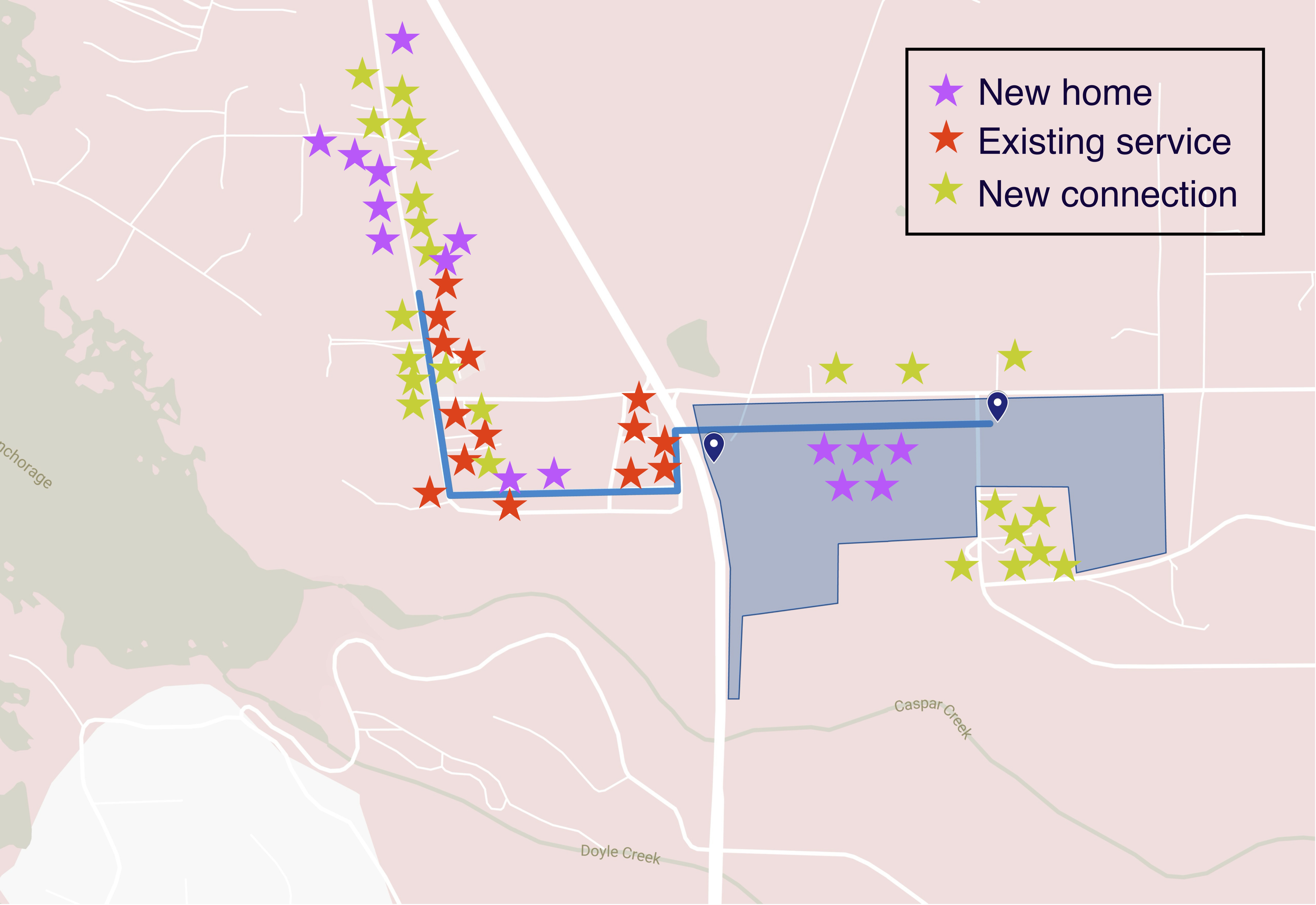
With a water district in place, we can break the cyclic dependency using a special zoning district. The image below shows what it would look like to grow the Caspar Water system to 50 connections by permitting 10 new homes west of the highway, 5 new homes east of the highway, and connecting up to 25 existing homes within the sphere of influence. Caspar village residents would reduce their risk of septic contamination in their drinking water.
The Elk district has been led for many years by a man named Charlie Acker who is widely respected on the coast, but Elk is not our only model. Point Arena is another small historic public water system on the Mendocino Coast, but its water system is owned and operated by a private individual named Billy Hay.
Either way, Caspar will try to develop itself. Form a water district and you will have a new public drinking water supply on the Coast, you might even attract another Charlie. Don't form a water district and you will have just another private water system, you might even attract another Billy.
Caspar: a modest suggestion about traffic
Caspar Water system today has a mile of water main to serve a dozen connections, which is not a sustainable configuration. A system this small has negative scale economies. If it were only ten houses, Caspar would never have built a community water system. Caspar Water maintains around 500 feet of water main per connection. It would be less expensive to operate private wells.
Water pipe is not the only thing Caspar has too much of following the mill's closure. Caspar has too much roadway. Caspar Frontage Road West (i.e., County Road 410B) is a particularly poor stretch of asphalt at the south end of the village. This road serves as the driveway for two parcels, both undeveloped, in addition to PG&E access.
The problem with this stretch of road is that a great many tourists enter Caspar looking for the beach or a scenic view. They follow the old Highway 1 expecting to find a parking lot or a beach, but what they find instead is a bad road and a loop back to the start. Anyone living at the south end of Caspar Road knows this: cars drive by all the time, looking for the beach, and then they either turn around and drive back, or they persist and loop around.
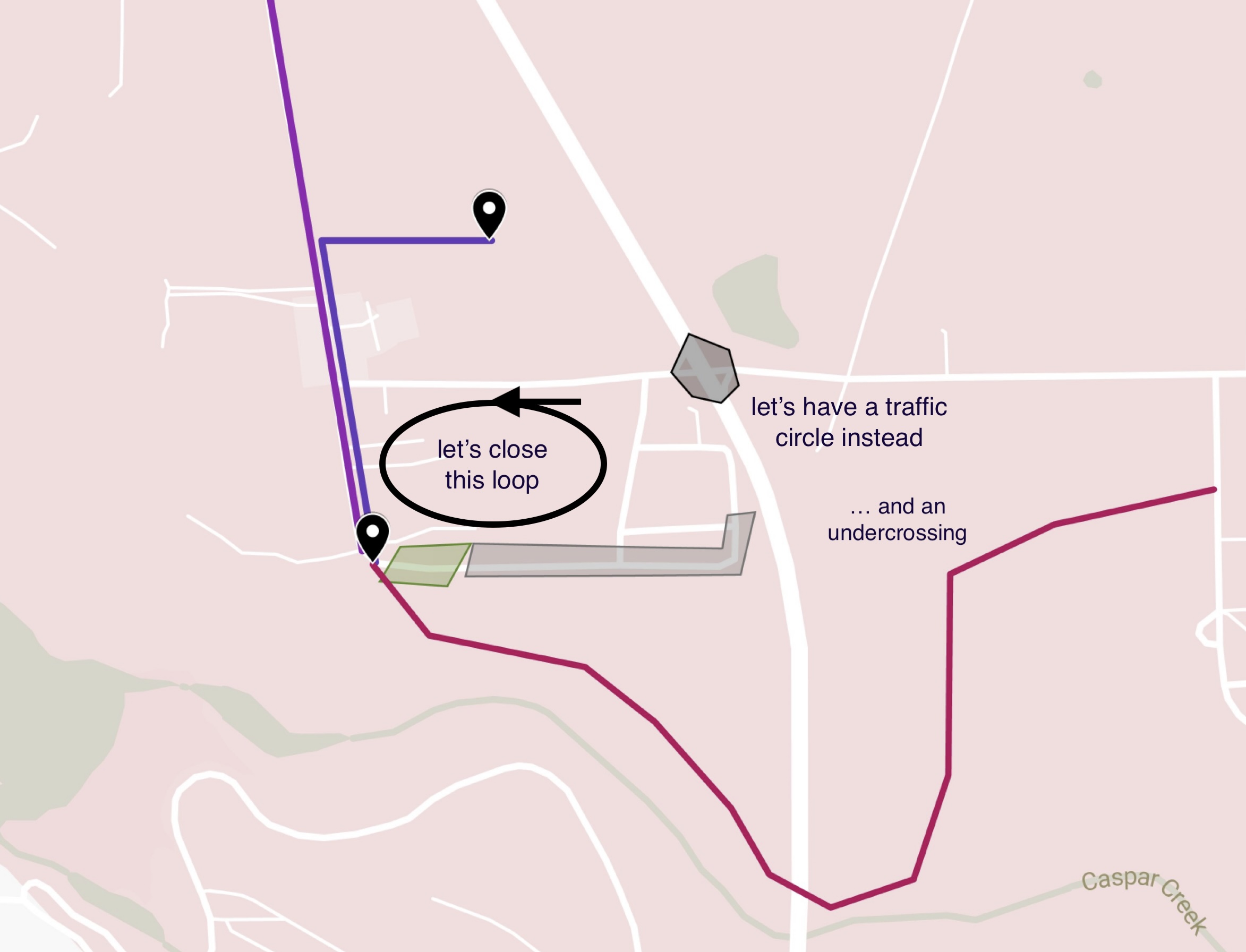
The County doesn't need to maintain this road, nor do the people of Caspar have a use for it. At the corner of town, where Highway 1 once sloped toward the creek, is an abandoned pullout used by visitors to the Caspar Headlands state park. This is the lowest point in town, which makes it the perfect place for a septic system recirculation tank. It could also be turned in to a nice parking lot, so that people can find the beach. We would abandon the road, giving easements to the two parcels that it served.
This corner of town was once the start of a trail to the base of the Caspar bridge. Wouldn't it be great if people could walk from the east side of Caspar to the west side of Caspar? Can we have a traffic circle at Fern Creek, for safety, too?